
Specialties02Conventional care
Notes that hold up when the auditor calls.
Mental-health parity enforcement finally has teeth, and prior-auth practices are under direct scrutiny. Behavioral health needs documentation built to survive an audit — not just read as a clinical note.
The compliance bar for behavioral health just moved. Parity enforcement now expects documentation that can stand next to medical and surgical benefits, and prior-authorisation practices are being examined directly. A clean clinical note is no longer the same thing as an audit-ready record — and that gap is a new, growing burden on practices that were already stretched.
Ona is built so the record is defensible by default. Notes draft against your own templates and every AI edit waits for your say-so, screeners like PHQ-9 and GAD-7 score themselves, consents keep the exact wording each patient signed, and eligibility and benefits are verified on the chart before the visit — so what you can prove keeps pace with what you do.
Three things behavioral health practices lean on.
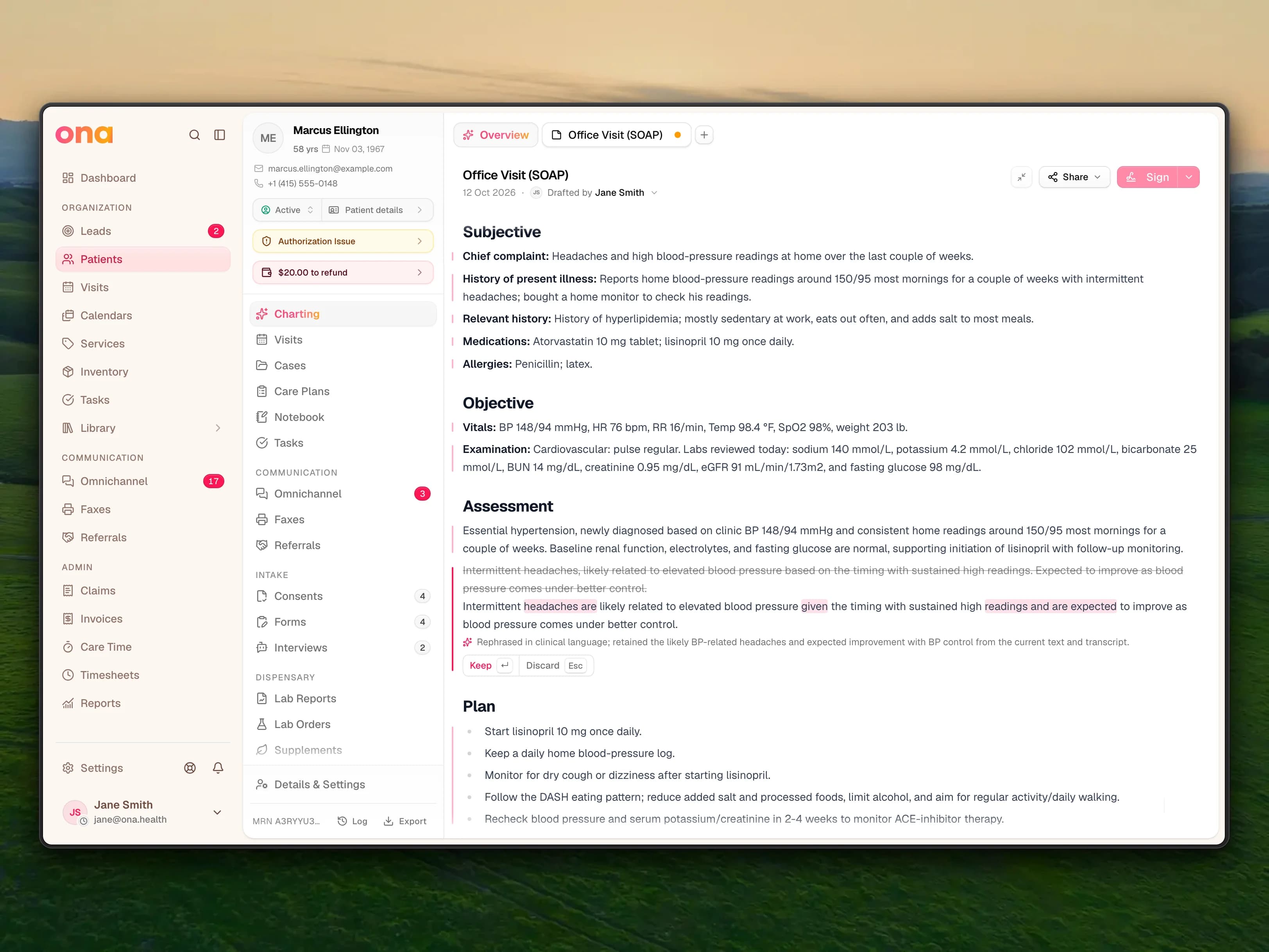
Each session drafts against DAP, BIRP or your own template from the recording, intake and chart, and nothing Ona changes afterward lands until you keep it. The result is a consistent, structured record — the kind an auditor can follow — without flattening your clinical voice.
From a verified benefit to a defensible record.
Step 01
Coverage is confirmed up front.
Real-time eligibility pulls co-pay, deductible and plan rules onto the chart before the first session — so the prior-auth conversation starts from facts, not guesses.
Step 02
The session opens on a clean screen.
Telehealth opens with camera and mic previews and a proper waiting room. Recording is a setting on each visit, and a recording consent can go out with intake before the session.
Step 03
The note lands structured.
The draft arrives against the template you chose — your sections, your shorthand — as a consistent, structured record rather than a free-text block an auditor has to untangle.
Step 04
The trail is ready before anyone asks.
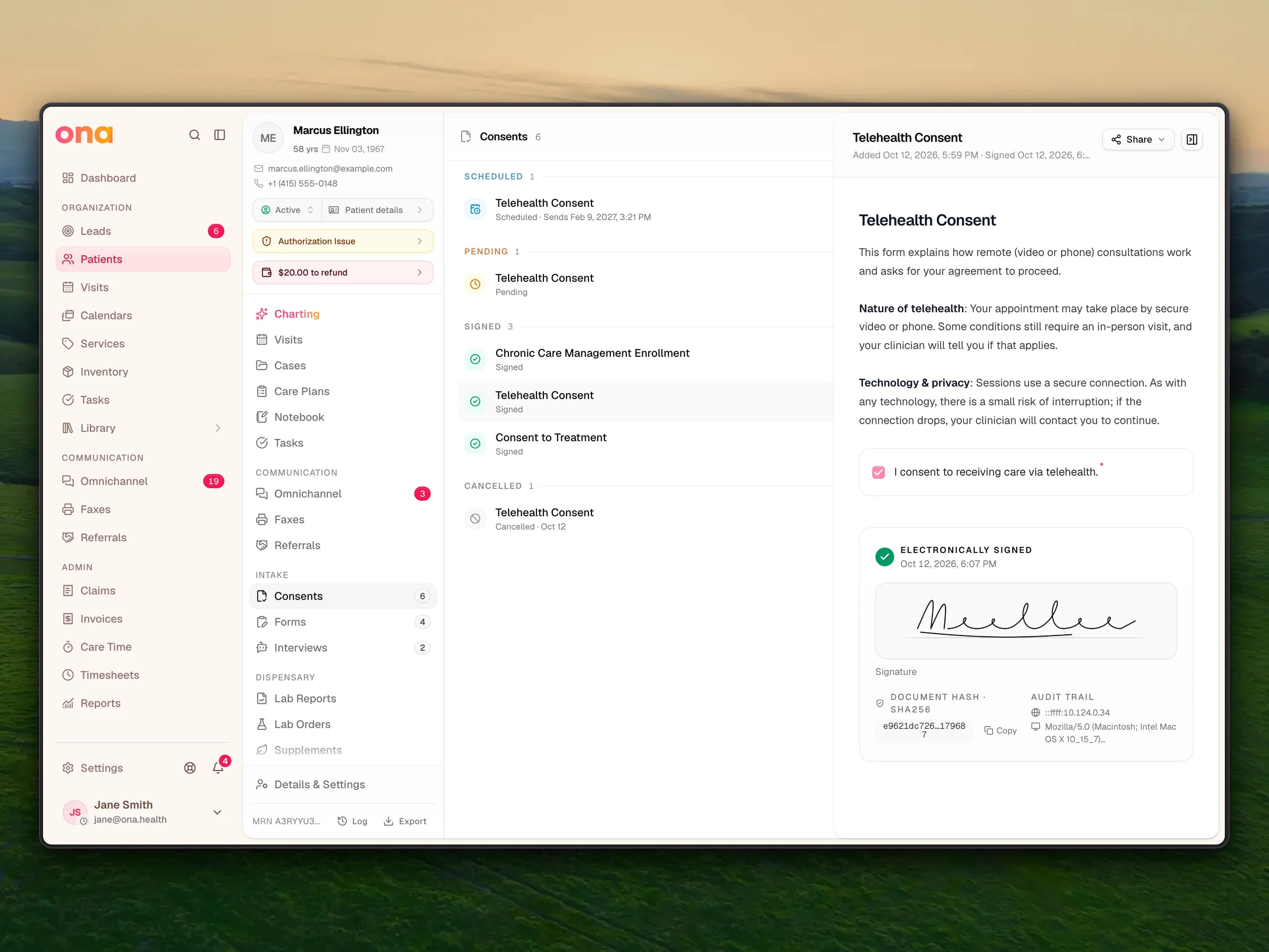
Signatures carry the time, IP address, browser and a hash of the exact wording; messages and consents live on the patient's chart. Pulling one is an export, not a fire drill.
Behavioral Health, answered.
How does Ona make documentation audit-ready?
Notes draft into a consistent structure, consents keep the exact wording each patient signed, and every signature captures the time, IP address, browser and a SHA-256 hash of the document. The record is defensible without extra after-the-fact work.
How do I end care with a patient properly?
Write a discharge or termination letter from the patient's chart: choose the type and the reasons that apply, set the effective date from your grace period, then sign it on screen or generate it unsigned for a pen signature. The final PDF is stored on the chart and can be downloaded or faxed.
Can patients opt out of being recorded?
Yes. Recording is a setting on each visit, so you can run any session without recording at all. There's no in-app consent banner; practices send a recording consent with intake instead.
Does Ona help with eligibility and prior auth?
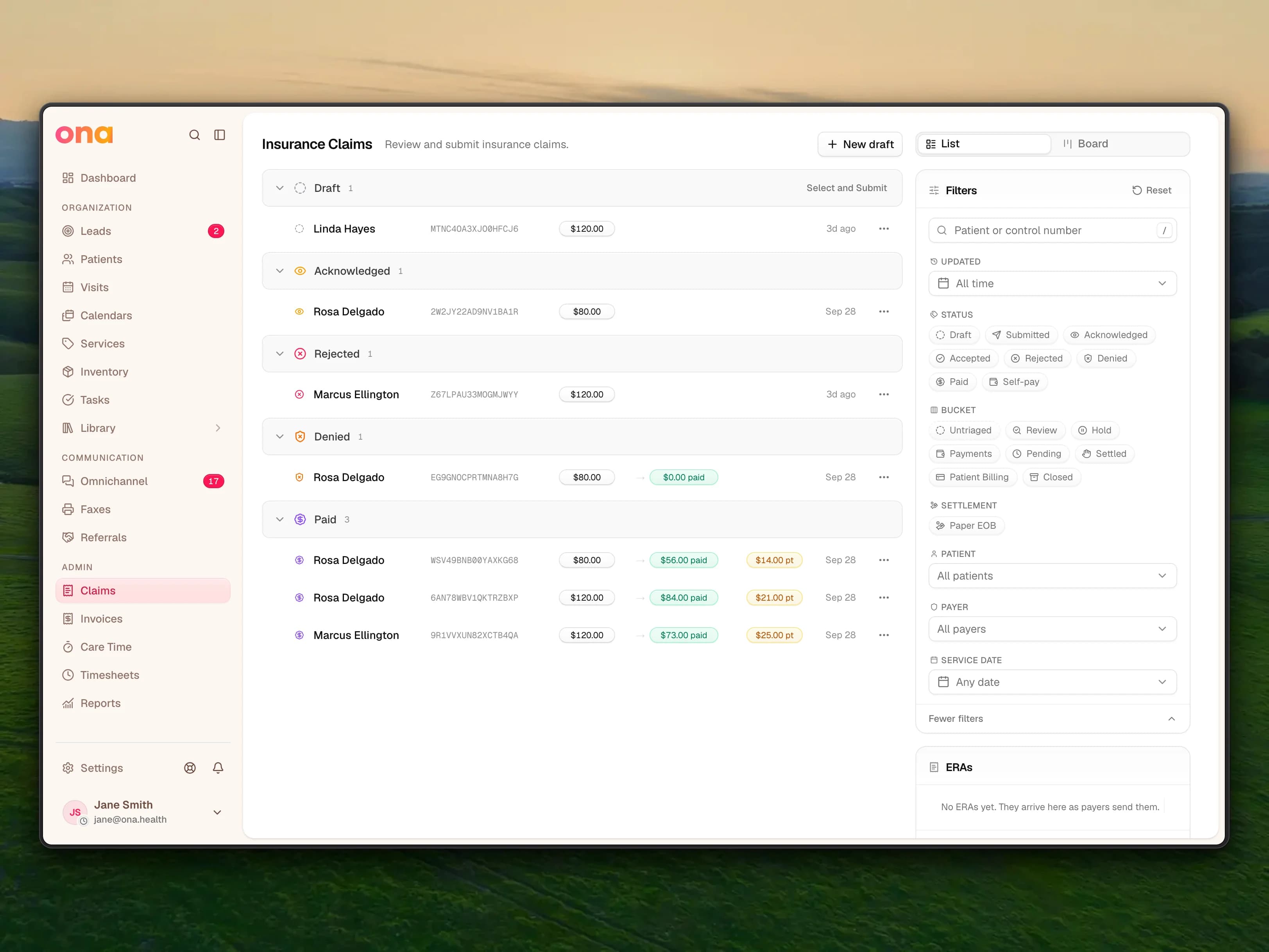
Real-time eligibility and benefits verification surfaces co-pay, deductible and plan details on the chart, and claim submissions and denials route back into the same workflow — so the coverage trail stays with the visit.
Is between-session messaging safe to use?
Yes. Chat is HIPAA-grade — encrypted in transit and at rest, role-scoped and logged to the patient record with full history — so the relationship stays warm without the liability of personal SMS.
See Ona in behavioral health.
Book a demo and we'll walk through your own workflows — no slides, no pitch.
- Live walkthrough
- Free data migration
- 14-day free trial